
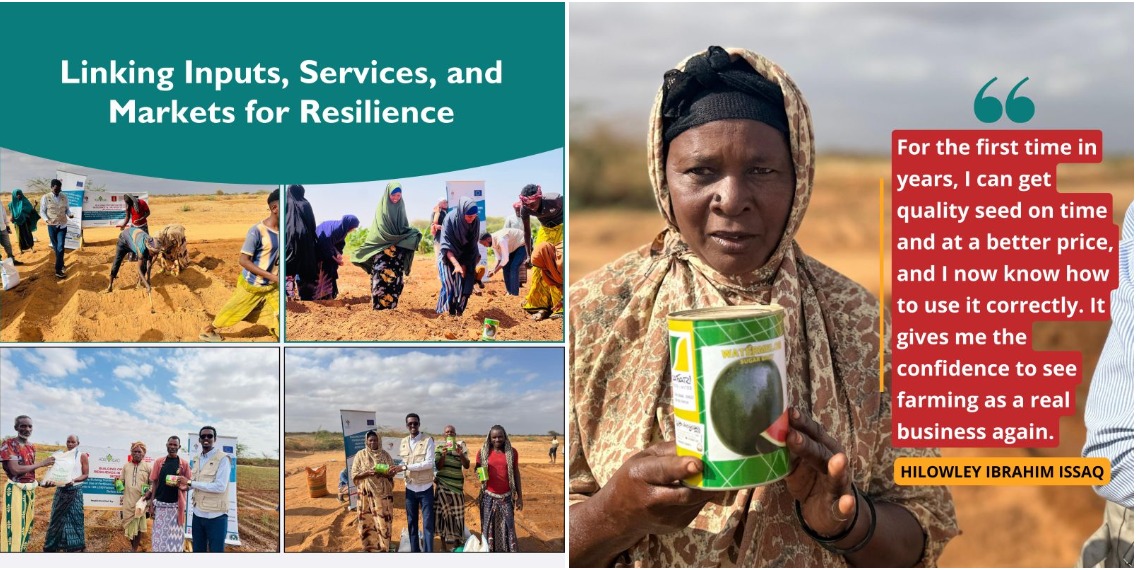
A new public–private partnership brokered by the BORESHA–NABAD programme is expanding farmers’ access to quality agricultural inputs and advisory services across Gedo to strengthen the region’s seed systems and extension networks.
Recent market and stakeholder assessments conducted across Dollow and Beled-Hawa revealed persistent challenges undermining farm productivity in the riverine areas.
The findings show that thin input markets, limited access to certified seed, and fragmented extension services continue to restrict farmers’ ability to commercialise production and adapt to climate stress.
As part of its evidence-led programming, BORESHA–NABAD mapped farmer cooperatives, local Agrovets, and public-sector actors across 10 locations.
This assessment identified critical system-wide gaps shaping farmer decision-making, including heavy reliance on informal input supply channels, overstretched government extension officers, and slow uptake of climate-smart practices due to weak linkages between cooperatives, suppliers, and the public sector.
To address these constraints, BORESHA–NABAD, implemented by the Danish Refugee Council (DRC Somalia), has facilitated a partnership bringing together Horn Agro Company, the Jubaland Ministry of Agriculture and Irrigation, and 10 farmer groups.
The collaboration directly links 420 farmers to certified seed and Agrovet supply chains while positioning government extension officers at the centre of technical follow-up and advisory support.
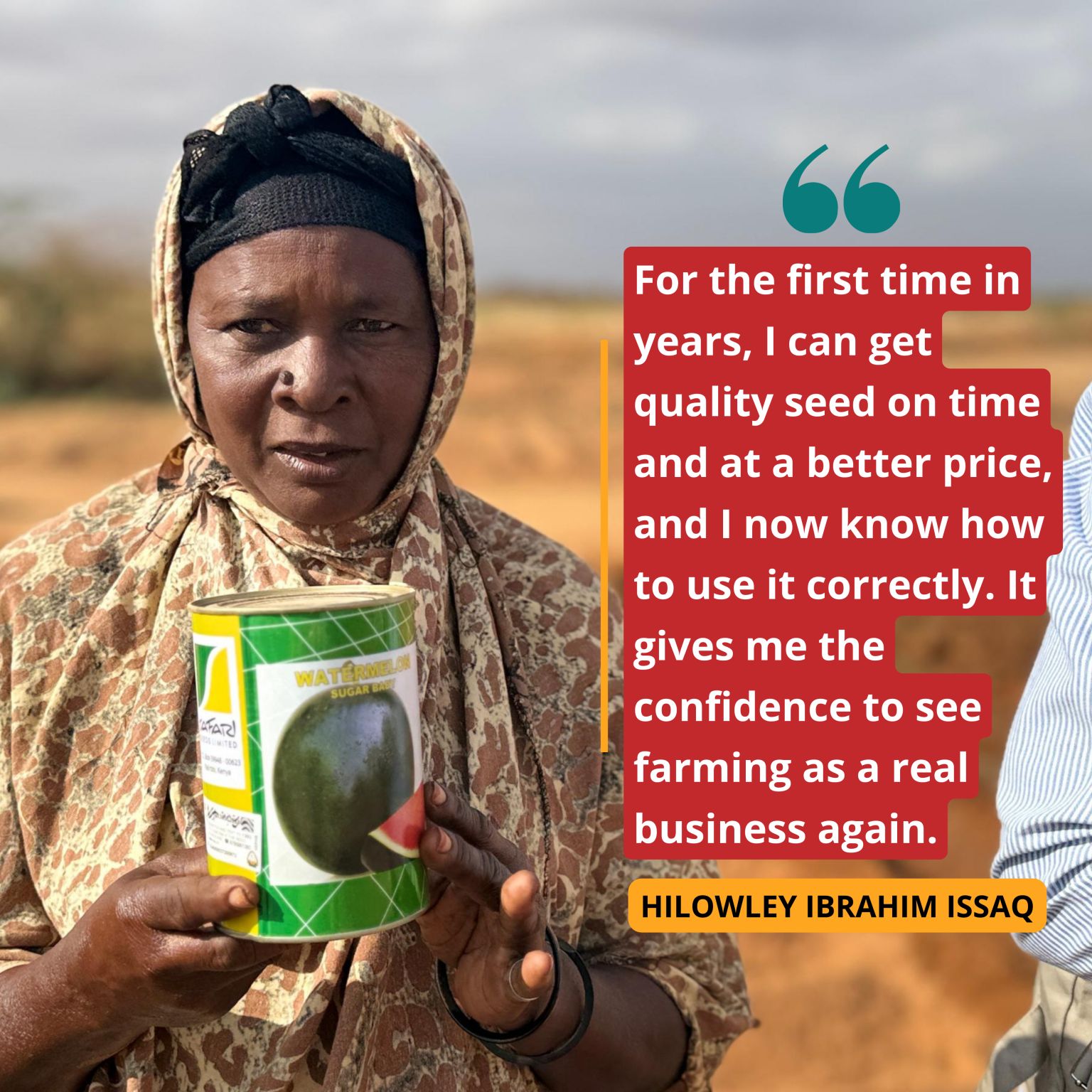
Under the new arrangement, farmers now access certified inputs, many through on-credit agreements, enabling them to adopt improved production practices with reduced financial barriers.
Government extension officers are providing regular, coordinated support to the farmer groups, offering guidance on fodder production, soil health, efficient fertiliser use, and improved pre- and post-harvest handling.
Early results point to stronger coordination between private suppliers, cooperatives, and public institutions, alongside increased adoption of market-ready and climate-smart practices.
Stakeholders say the shift marks an important move away from direct input distribution toward a more sustainable systems approach.
According to BORESHA–NABAD, the long-term goal is to ensure that seed producers, Agrovets, and cooperatives can continue delivering essential services beyond the programme’s lifecycle, helping Gedo’s agricultural markets become more resilient, responsive, and capable of supporting farmers through changing climate conditions.