
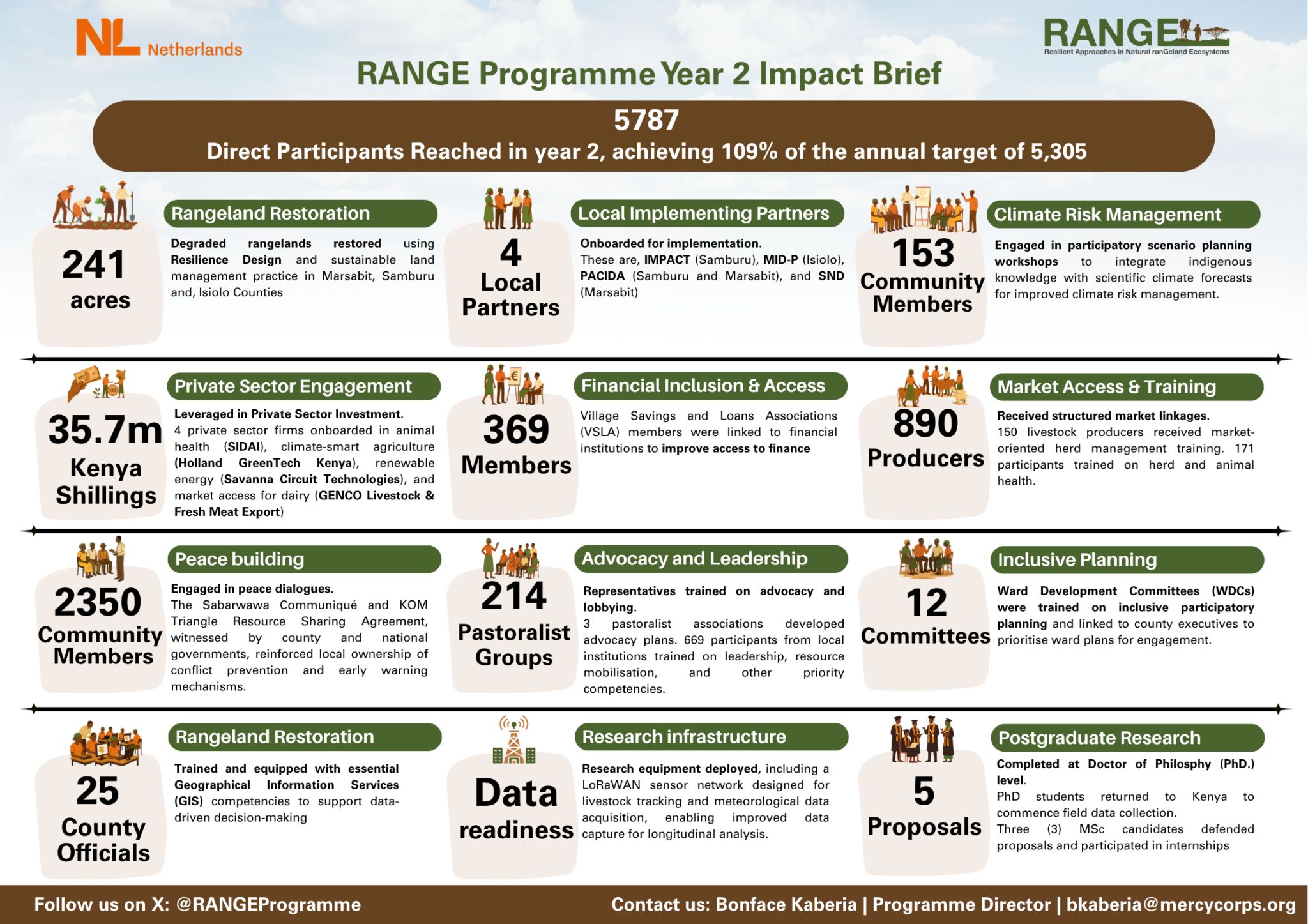
The RANGE Programme implemented by Mercy Corps Kenya has exceeded its annual targets, reaching 5,787 participants across northern Kenya and reinforcing efforts to build resilient communities in arid and semi-arid lands (ASALs).
According to the program's Year 2 Impact Snapshot, the initiative achieved 109 per cent of its participation target, highlighting strong community engagement and growing demand for resilience-focused interventions.
The program is being implemented across Marsabit County, Samburu County, and Isiolo County, regions that frequently face climate shocks such as drought and resource-based conflicts.
Beyond participation numbers, the program has made notable environmental gains, restoring 241 acres of degraded rangeland.
This restoration effort is expected to improve pasture availability, support livestock-based livelihoods, and enhance ecosystem sustainability in the targeted counties.
The program has also catalysed economic opportunities by leveraging KSh35.7 million in private sector investment.
Additionally, 890 producers have been connected to market opportunities, strengthening local market systems and improving income prospects for pastoralist communities.
A key pillar of the RANGE program is its integrated approach to resilience.
Over the past year, communities have benefited from improved climate risk management strategies that combine indigenous knowledge with modern forecasting techniques.
This has enabled more informed decision-making at the household and community levels.
Access to finance has also expanded through linkages with Village Savings and Loans Associations (VSLAs), providing communities with critical financial tools to invest in livelihoods and cope with economic shocks.
At the same time, the program has supported peacebuilding initiatives aimed at strengthening local ownership of conflict prevention mechanisms, an essential component in regions where competition over natural resources often fuels tensions.
Investment in research and data systems has further enhanced the program's impact by supporting evidence-based planning and long-term decision-making among stakeholders, including county governments, private sector actors, and local institutions.
Mercy Corps Kenya says the achievements reflect a systems-based approach that integrates livelihoods, ecosystems, markets, and governance.
By fostering collaboration among communities and key stakeholders, the RANGE program continues to demonstrate how coordinated efforts can deliver sustainable resilience outcomes in some of Kenya’s most vulnerable regions.
As the program progresses, stakeholders remain optimistic that scaling such integrated interventions will further strengthen community resilience and secure livelihoods in northern Kenya.