
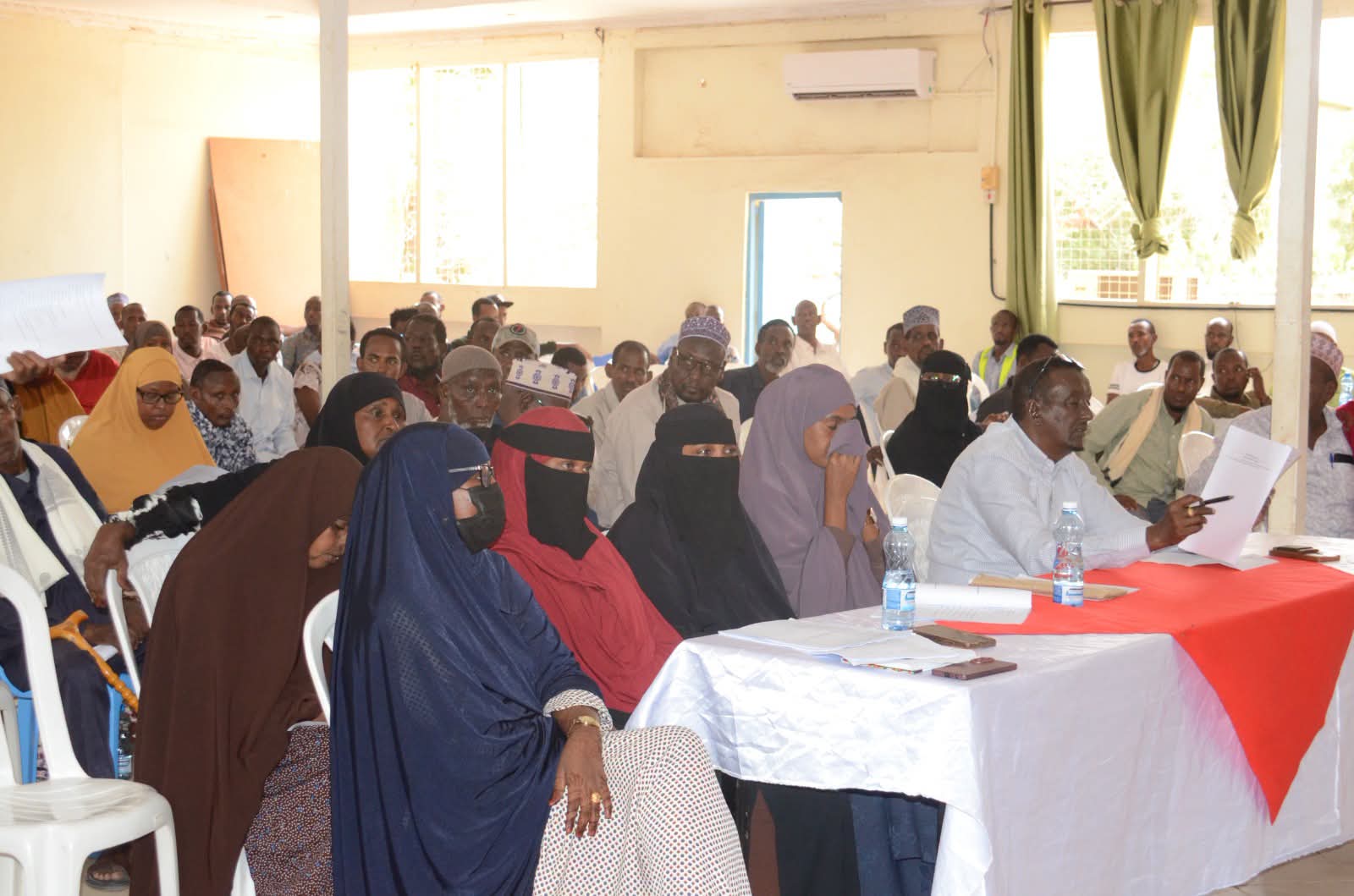
Garissa residents have urged the National Land Commission (NLC) to abolish the colonial-era three-mile boundary rule between Garissa and Tana River counties, saying it has contributed to recurring land conflicts, deaths and loss of property.
The residents want the NLC to revisit the disputed 4.8-kilometre strip and address longstanding concerns over land ownership, access to water and administrative boundaries that date back to the colonial period.
NLC commissioners have acknowledged the three-mile strip as a historical land injustice and said the commission would revisit the matter under the proposed National Land Commission (Historical Land Injustices) Regulations, 2026.
Residents of Garissa County have called on the National Land Commission (NLC) to abolish the controversial three-mile boundary rule separating Garissa and Tana River counties, saying the colonial-era arrangement has contributed to recurring land conflicts, deaths and loss of property.
The residents made the call during a public participation forum on the proposed National Land Commission (Historical Land Injustices) Regulations, 2026, held in Garissa.
They want the NLC to expedite the review of the disputed strip and address what they described as a historical land injustice that has continued decades after Kenya gained independence.
The disputed three-mile strip is a colonial-era administrative arrangement covering land running parallel to the Tana River on the Garissa side.
The rule, which established an approximately 4.8-kilometre strip, was introduced during British colonial rule amid concerns over the administration and security of Kenya's Northern Frontier areas.
Residents say the historical arrangement has remained a source of tension despite the country's transition to independence and subsequent changes in administrative boundaries.
According to residents, the continued dispute over the strip has affected access to land, water and other resources along the Tana River, particularly for pastoralist communities.
They argue that the situation has contributed to recurring tensions between communities and disputes over the administration and use of land.
Some of the areas affected include parts of Balambala, Garissa Township, Bura East and Ijara sub-counties.
The residents told the NLC that the disputed boundary should be reviewed and the land returned to Garissa.
They also expressed concern that successive governments failed to adequately consult local communities after independence when administrative districts were being subdivided, resulting in the retention of boundaries established during the colonial period.
The residents said a fresh review was necessary to address longstanding grievances and provide a lasting solution to disputes that have affected communities living along the Garissa-Tana River boundary.
The matter has previously been the subject of legal proceedings.
Last year, the Environment and Land Court in Garissa issued temporary orders stopping new settlements and expansion activities along the disputed three-mile strip following a petition by Ijara MP Abdi Ali Abdi.
The petition alleged that Tana River County leadership was encroaching into territory claimed by Garissa.
In a ruling delivered by Justice J. Mutungi, the court directed the parties to maintain the status quo, effectively freezing new developments in the contested area pending the hearing and determination of the case.
The orders barred the Tana River County administration from establishing new settlements or expanding existing ones in the disputed area.
NLC commissioners attending the public participation forum said the commission would review the issues once the new regulations are adopted, with determinations guided by the law.
NLC Commissioner Daniel Muriungi said the commission had heard concerns involving a significant number of public institutions and administrative areas affected by the dispute.
“We have heard that there are at least 60 schools, markets, and five sub-counties which are involved. Now with these new regulations, once adopted by Parliament, we will be able to listen to the issues and determine them as per the law,” Muriungi said.
Commissioner Esther Murugi said some historical land claims had previously faced delays because of limitations relating to the commission's mandate.
She explained that changes to the land laws had extended the framework for addressing historical land injustices, allowing the commission to consider claims that could not previously be pursued because of expired timelines.
“We are here to sensitise the citizens on how they should submit claims and what is expected for both the claimants and the NLC,” Murugi explained.
Murugi specifically acknowledged the three-mile strip dispute as one of the significant historical land issues raised during the Garissa forum.
“Some very interesting issues have come up in Garissa especially on the three-mile strip, that is a historical land injustice. It has been heard before and determined but the citizens here are not happy with the determination, so we shall revisit the issue so that we can address it afresh,” she said.
Her remarks offer residents an opportunity to present their concerns under the renewed framework for historical land injustice claims.
The commission's position also signals a potential new phase in efforts to resolve the longstanding dispute, although any eventual determination will have to follow the applicable legal and regulatory process.
The proposed National Land Commission (Historical Land Injustices) Regulations, 2026 establish procedures for handling historical land injustice claims.
The regulations provide for the initiation, receipt, admission, registration and investigation of claims, as well as their determination and the recommendation and implementation of appropriate forms of redress.
The public participation exercise is intended to give communities an opportunity to understand the proposed framework and submit issues relating to historical land injustices.
For Garissa residents, the process provides an avenue to revive their longstanding concerns over the three-mile strip and seek a fresh determination of the dispute.
The Garissa-Tana River boundary dispute has wider implications for communities whose livelihoods depend heavily on access to land and water resources.
The Tana River is an important resource for households, pastoralists, farmers, schools and other institutions in the region.
Residents argue that uncertainty over the ownership and administration of the disputed strip has made access to these resources more difficult and has contributed to tensions between communities.
They now want the NLC to use the historical land injustices framework to examine the origins of the boundary, consider the grievances of affected communities and determine the matter in accordance with the law.
The renewed process could provide an opportunity for stakeholders to address a dispute that has persisted from the colonial period into independent Kenya.
For residents who have lived with the consequences of the disputed boundary for decades, the demand is straightforward: a fresh review of the three-mile strip and a legally guided resolution to the longstanding land dispute.