
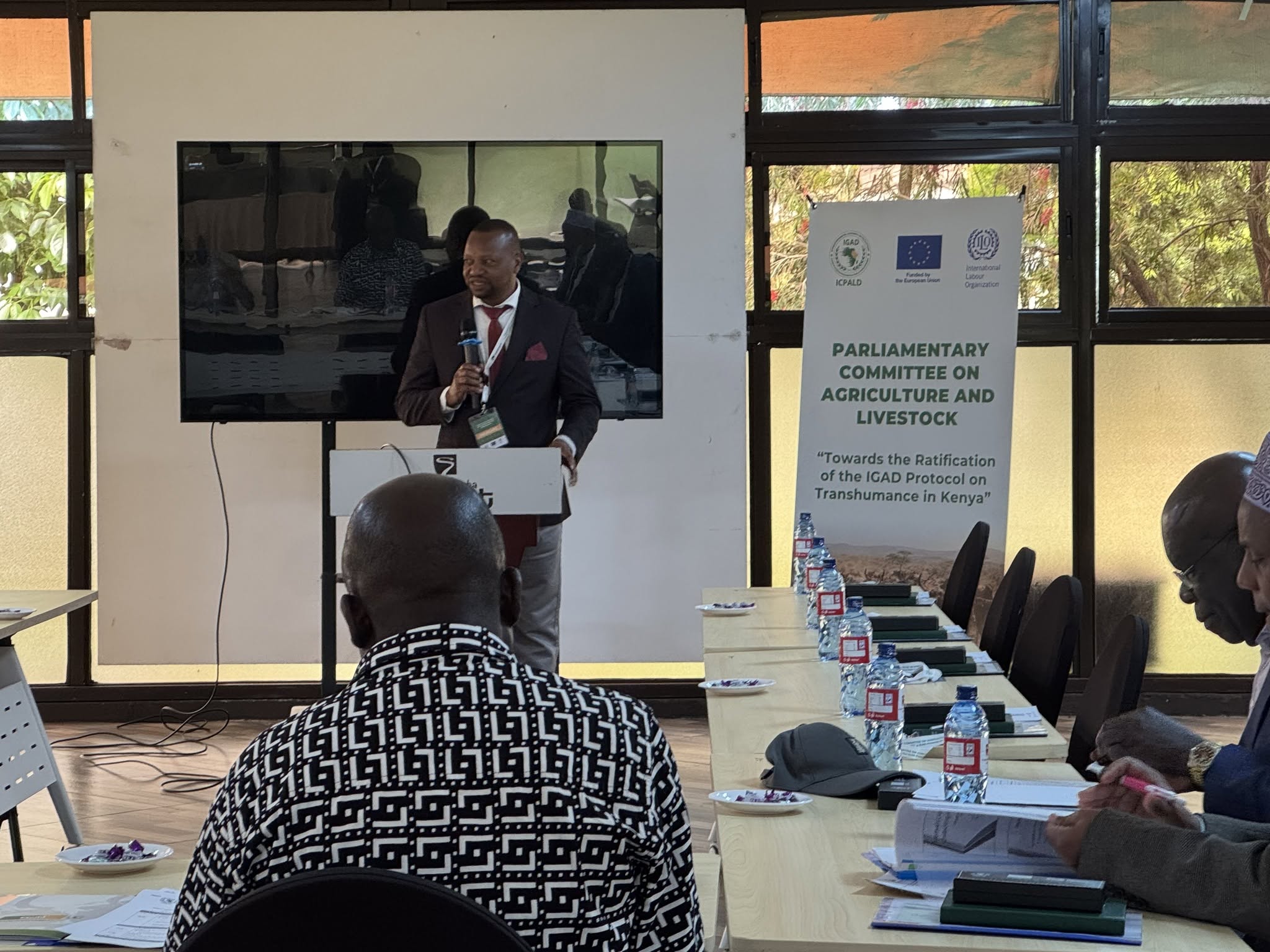
Kenya is advancing efforts to ratify the IGAD Transhumance Protocol as MPs, policymakers and government technical partners build consensus on its implementation.
ICPALD is supporting the development of an inter-ministerial legislative roadmap to guide the Protocol’s domestication through national pastoral laws and policies.
The EU-funded initiative aims to strengthen pastoral mobility, cross-border coordination and livestock development through implementation of the IGAD Transhumance Protocol.
Kenya has stepped up efforts to ratify and domesticate the IGAD Protocol on Transhumance, with Members of Parliament, policymakers, and government technical partners engaging on the legislative measures needed to bring the regional framework into effect nationally.
The latest engagement, convened by the IGAD Centre for Pastoral Areas and Livestock Development (ICPALD), focused on building parliamentary consensus and accelerating approval of the ratification instrument. The meeting was held in Naivasha in September 2026.
The discussions brought together key legislators, policymakers, and government technical partners to review the requirements for implementing the Protocol and map the legislative steps needed to domesticate it in Kenya.
According to ICPALD, the priority was to sensitise Members of Parliament on the implementation requirements, formalise an inter-ministerial legislative roadmap and lay the groundwork for subsequent national pastoral laws and policies aligned with the regional instrument.
The initiative is supported by the European Union as part of wider efforts to advance the ratification, domestication and implementation of the IGAD Transhumance Protocol across member states.
Kenya officially signed the IGAD Protocol on Transhumance in June 2024, becoming the fifth IGAD member state to sign the instrument at the time.
The Protocol was adopted by the IGAD Council of Ministers in June 2021 and provides a regional framework for the free, safe and orderly cross-border movement of pastoralists and livestock in search of water and pasture.
Following Kenya's signing, the instrument was expected to proceed through the country's ratification procedures, including consideration by the National Assembly. ICPALD has since supported national engagements aimed at advancing the process.
The current parliamentary engagement therefore represents a further step in translating Kenya's commitment to the regional instrument into national legislation, policies and implementation mechanisms.
The IGAD Transhumance Protocol is designed around the realities of pastoral production systems, where seasonal movement of livestock is an important strategy for accessing pasture and water.
The framework seeks to facilitate cross-border livestock mobility while providing mechanisms for coordination among neighbouring countries.
It also addresses challenges associated with pastoral mobility, including conflict, resource competition, livestock diseases and unregulated cross-border movement.
Under the Protocol, member states are expected to strengthen cooperation and coordination and develop appropriate national frameworks to support safe and orderly transhumance.
The implementation roadmap also envisages mapping and designation of transhumance corridors and strengthening cross-border governance structures.
A key focus of the latest Kenyan engagement is the development of national laws and policies that would domesticate the Protocol.
This includes establishing an inter-ministerial legislative roadmap to guide the process and ensure that relevant government institutions are aligned on the legal and policy measures required.
The process builds on earlier consultations involving the Pastoralist Parliamentary Group, parliamentary committees, the Attorney General's Office and government departments responsible for foreign affairs, livestock, agriculture, internal security and ASAL development.
In an earlier 2024 policy meeting, government officials and stakeholders identified ratification and domestication as important steps towards creating a more coordinated framework for pastoral mobility. The consultations also highlighted the need for public participation as part of Kenya's parliamentary procedures for ratifying international instruments.
For pastoral communities, the Protocol could provide a more predictable framework for seasonal movement across national borders in response to changing availability of water and pasture.
Pastoral mobility is particularly important in the arid and semi-arid lands, where drought, erratic rainfall and resource pressures can force livestock keepers to move in search of grazing and water.
A coordinated regional framework is intended to reduce uncertainty around such movements while strengthening cooperation between countries and communities sharing livestock corridors.
The Protocol also links transhumance governance to conflict prevention and peaceful coexistence. Its framework provides for the use of local institutions, the IGAD Conflict Early Warning and Response Mechanism and bilateral mechanisms to address disputes arising from transhumance.
The push for ratification also comes as IGAD member states seek to strengthen pastoral economies and livestock value chains across the region.
IGAD has identified transhumance as an important component of pastoral production and regional economic activity. The Protocol is intended to help unlock the social and economic potential of pastoralism while improving governance of cross-border livestock movement.
At regional level, IGAD has continued to call on member states to accelerate the signing, ratification, domestication and operationalisation of the Protocol, including alignment with national policy and legislative frameworks.
The regional body has also emphasised the importance of addressing insecurity and resource-based conflicts that restrict pastoral mobility, alongside mapping and formalising transhumance corridors.
The Kenyan process is supported by the European Union through IGAD's broader transhumance programme.
ICPALD says the programme supports member states to ratify and domesticate the Protocol, establish cross-border transhumance governance and coordination mechanisms, and facilitate the mapping and designation of transhumance corridors.
The EU-backed support forms part of wider regional efforts to strengthen pastoral resilience and promote more orderly livestock mobility across the Horn of Africa.
As Kenya advances the parliamentary process, the focus will now be on building consensus among legislators and government institutions, developing the necessary legislative roadmap and translating the regional commitments into national laws and policies.
The process is expected to provide the foundation for Kenya's eventual implementation of the IGAD Transhumance Protocol and strengthen coordination around pastoral mobility, livestock development and cross-border resource management.