
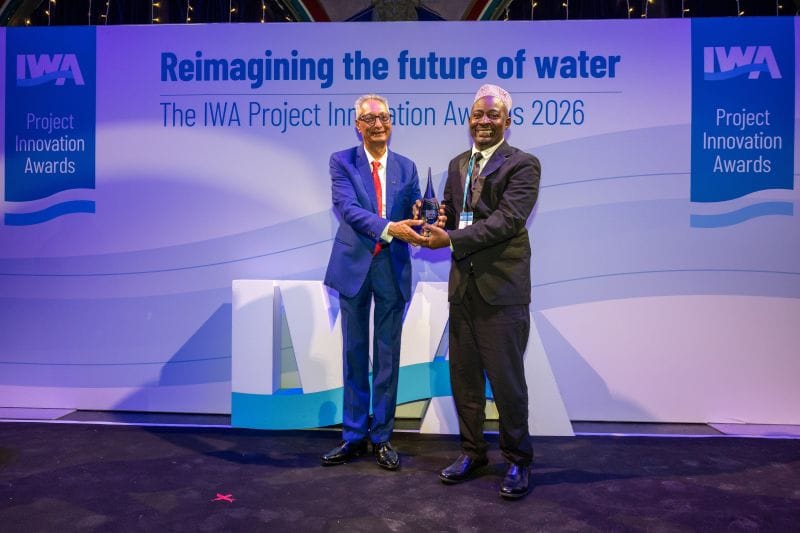
Lamu County’s Kiunga Solar Desalination and Water-for-Peace Initiative has won Gold at the 2026 International Water Association Project Innovation Awards in Glasgow, earning global recognition for its innovative approach to water security and peacebuilding.
The solar-powered desalination project provides approximately 5,000 litres of safe water per hour to 573 households and about 3,500 people in Kiunga, while supporting schools and health facilities.
Recognised as the only African winner among the 2026 IWA Project Innovation Award recipients, the Kiunga initiative demonstrates how renewable energy, appropriate technology and community-centred solutions can address water scarcity while fostering peaceful relations across the Kenya-Somalia border.
Lamu County has earned international recognition after its Kiunga Solar Desalination and Water-for-Peace Initiative won Gold at the 2026 International Water Association (IWA) Project Innovation Awards in Glasgow, Scotland.
The project was named the Gold winner in the Governance, Institutions and Social Enterprise category, placing Lamu County among a select group of water innovators recognised at the global awards.
The recognition was announced during the IWA Project Innovation Awards ceremony held in Glasgow on October 6, 2026.
The award is particularly significant for Kenya and Africa, with the Kiunga initiative emerging as the only African project among the 2026 IWA Project Innovation Award winners, according to the published results.
The awards attracted 320 submissions from 65 countries, with only 24 projects selected as winners across six categories.
The award-winning initiative was developed to address persistent water scarcity in Kiunga, a remote coastal community in Lamu County near Kenya's border with Somalia.
The area faces significant water challenges, including limited access to reliable freshwater sources. The Kiunga project has responded to this challenge by combining solar energy and desalination technology to transform saline groundwater into safe water for the community.
The system produces approximately 5,000 litres of safe water every hour and distributes the water through a 15.1-kilometre network.
The network currently serves 573 households and approximately 3,500 people, while also supporting essential institutions including schools and health facilities. The water network has additionally been extended towards neighbouring Ishakani.
By using solar power to drive the desalination process, the initiative provides a locally appropriate approach to water security while reducing reliance on conventional energy sources.
Beyond its technological innovation, the Kiunga project has gained attention for the way it links water access with peacebuilding and community relations.
Kiunga's location along the Kenya-Somalia border means that people from neighbouring Jubaland, Somalia, also cross into Kenya to access clean water.
The shared access to this essential resource has created opportunities for interaction between communities living on opposite sides of an international border.
For Lamu County, this experience has demonstrated how access to basic services can contribute to peaceful coexistence and strengthen relationships between communities.
This thinking gave rise to the project's defining concept: Water for Peace.
The initiative therefore goes beyond infrastructure. It seeks to demonstrate how development interventions can simultaneously address immediate community needs while contributing to resilience, dignity and peace.
Receiving the award in Glasgow on behalf of the Lamu County Government and Governor Issa Abdalla Timamy, Shee Kupi Shee, Director of Disaster Risk Management and Peace Building in Lamu County, described the recognition as an important milestone for the county and the people of Kiunga.
“This is a very proud moment for Lamu County. I am deeply honoured to receive this Gold Award on behalf of H.E. Governor Issa Abdalla Timamy, the Lamu County Government and, most importantly, the people of Kiunga,” Shee said.
He added that the recognition reinforces the idea that water infrastructure can have impacts that extend beyond service delivery.
“This recognition validates an idea we strongly believe in: that water is not just a basic service, it can be an instrument for resilience, dignity and peace,” he said.
Shee, who is the architect of the Kiunga Water-for-Peace model, received the award on behalf of the county government.
The recognition also highlights the role of the Lamu County Government under Governor Timamy's leadership in supporting locally driven solutions to the county's development challenges.
Rather than being an individual achievement, the award represents the contribution of the county government, technical teams, communities and partners involved in developing and implementing the initiative.
The Kiunga initiative comes at a time when water scarcity, climate change and environmental vulnerability are placing increasing pressure on communities across Africa.
For remote and arid or semi-arid communities, conventional water infrastructure can be difficult and expensive to establish and maintain.
The Kiunga experience demonstrates how combining renewable energy, appropriate technology, community participation and locally informed planning can create solutions suited to challenging environments.
The use of solar-powered desalination is particularly relevant in coastal communities where saline groundwater may be available but cannot be consumed without treatment.
The project therefore offers an example of how technological innovation can be adapted to address a specific local challenge rather than relying solely on conventional water supply models.
For Shee, the philosophy behind the Kiunga project is also connected to his experience in peacebuilding and social innovation.
He credits the Rotary Peace Fellowship and Bahçeşehir University in Türkiye with helping strengthen his approach to innovative peacebuilding.
During his fellowship, his social change initiative focused on refugee integration and explored ways of enabling displaced populations and host communities to coexist with dignity and inclusion.
That experience helped shape his belief that sustainable solutions should bring communities together rather than deepen divisions.
“The Rotary Peace Fellowship gave me an opportunity to sharpen my thinking and practice around innovative peacebuilding. My social change initiative focused on refugee integration, and that experience strengthened my belief that sustainable solutions must bring communities together rather than divide them,” he said.
The philosophy has subsequently informed the Water-for-Peace approach in Kiunga, where access to water has become an avenue for interaction between communities on both sides of the Kenya-Somalia border.
The Gold Award gives Lamu County an opportunity to showcase its experience to international water institutions, development partners, technical organisations and potential investors.
It also places a spotlight on the capacity of African communities to develop solutions to complex challenges using locally available resources and appropriate technology.
The recognition is particularly notable because the winning project originated in a remote border community rather than a major urban centre or highly resourced environment.
For Lamu County, the achievement strengthens its profile in areas including water security, climate resilience, disaster risk management and peacebuilding.
The project also demonstrates the potential for county-level governments to develop and implement innovations that can attract international attention.
The story of Kiunga offers a powerful example of how a local development challenge can inspire an internationally recognised solution.
A community facing persistent water insecurity has developed a model that combines solar energy, desalination, water infrastructure and peacebuilding.
The project now has a global platform through the IWA Project Innovation Awards, giving Lamu County an opportunity to share lessons from Kiunga with communities and institutions confronting similar challenges elsewhere.
At its core, the initiative demonstrates that water can be more than a basic service. In the right circumstances, access to water can support health, livelihoods, dignity, resilience and stronger relationships between communities.
For the people of Kiunga, the Gold Award represents recognition of a solution developed to address a very local challenge. For Lamu County and Kenya, it represents international recognition of African innovation and the potential of locally driven development.
As Governor Timamy put it: “Water connects us. Water sustains us. And water can build peace.”