
Turkana County Government and WASH partners have unveiled a new reporting tool designed to standardise data, track interventions and strengthen coordination of water, sanitation and hygiene services across the county.
The county is also set to progressively transition 23 water systems serving refugee settlements in Kakuma and Kalobeyei to KALWASCO over two years, strengthening government-led and sustainable service delivery.
Turkana’s WASH partners have identified reliable data, infrastructure investment, government-led services, preparedness and stronger links between WASH and health as key areas for joint action.
The Turkana County Government and Water, Sanitation and Hygiene (WASH) partners have agreed on measures to strengthen coordination, accountability and sustainability of WASH services across the county.
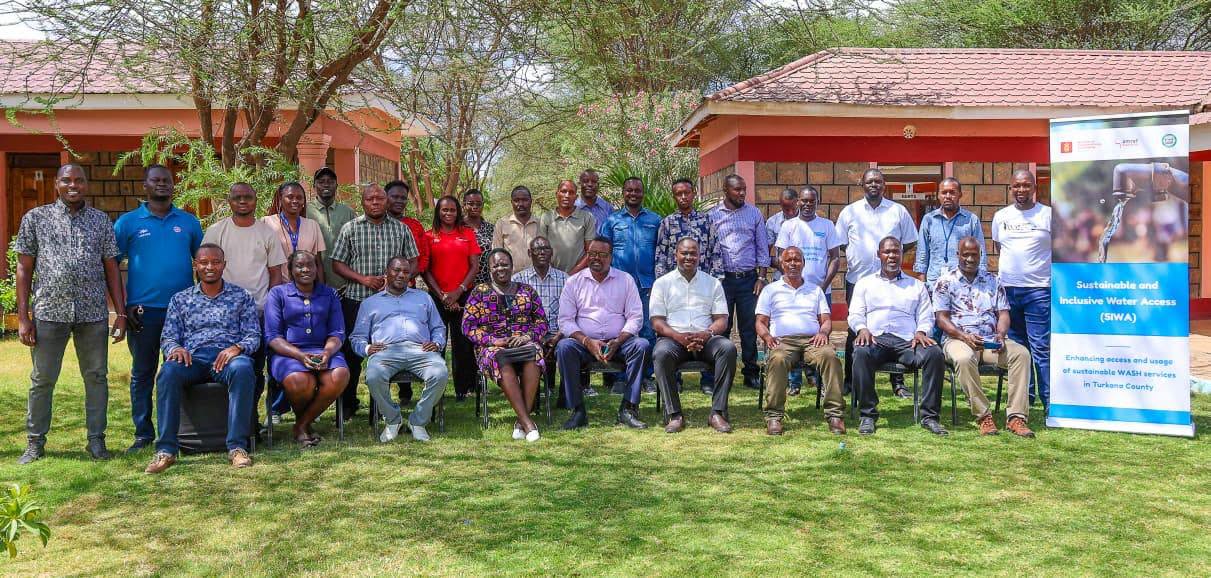
The agreement was reached during a WASH coordination meeting held in Kakuma on September 23, 2026, in collaboration with Amref Health Africa, where county officials and partners reviewed ongoing interventions and identified priority areas for joint action.
A key outcome of the meeting was the development of the Turkana County WASH Partners Reporting Tool, which is designed to standardise reporting and provide reliable data on water, sanitation and hygiene service delivery across the county.
The reporting tool is expected to provide a common framework for partners to document their WASH interventions and enable the county government to obtain a clearer picture of activities being implemented across Turkana.
According to the county government, the tool will help track interventions, reduce duplication and identify areas requiring follow-up by both the county government and development partners.
The data generated will also feed into county and national government reporting platforms, supporting more coordinated planning and monitoring of WASH services.
Presenting the draft tool, Godfrey Akolong, Director for the Kalobeyei Integrated Socio-economic Development Plan (KISDEP), described it as a “game changer” that would support future WASH programming and evidence-based decision-making.
Agnes Mana, Chief Officer for Preventive and Promotive Health Services, welcomed the initiative, saying reliable and trackable data would strengthen evidence-based planning and implementation.
She called for continued collaboration between the county government and WASH partners, particularly in supporting the integration of refugee communities and improving preparedness for flooding and storm-water impacts.
The coordination meeting also agreed on the gradual transition of 23 water systems serving refugee settlements to the Kalobeyei Water and Sanitation Company (KALWASCO).
The transition is part of efforts to strengthen government-led and sustainable WASH service delivery while maintaining continuity of services for refugee and host communities.
Of the 23 systems, 19 are located in Kakuma and four in Kalobeyei.
The transition will be implemented progressively over a two-year period under the WASH Inclusion and Transition Workplan, with support through KISDEP and the Shirika Plan.
The county government said the process is expected to strengthen institutional ownership and integrate WASH services more firmly into government systems.
The move will also provide a framework for ensuring that existing water infrastructure continues to serve communities as responsibility for management gradually shifts to the county-linked water utility.
Kakuma Municipality is also developing a WASH Infrastructure Development and Investment Plan covering several areas of water, sanitation and environmental management.
The plan will address water supply, sanitation and hygiene, faecal sludge management, storm-water drainage, solid waste management and climate resilience.
It is expected to provide a coordinated framework for future WASH investments within Kakuma and help align implementation with municipal spatial plans, county planning instruments and national WASH policies and legislation.
The approach is intended to ensure that investments in WASH infrastructure are coordinated and linked to broader development and planning priorities.
The meeting identified five priority areas requiring continued collaboration between the county government and WASH partners.
These include reliable WASH data, critical infrastructure investment, government-led service delivery, protection and preparedness, and stronger links between WASH and health.
The health component will include attention to neglected tropical diseases, with county officials highlighting the relationship between access to safe water and sanitation and the prevention of certain diseases.
James Ekamais, County Neglected Tropical Diseases Coordinator, noted that conditions including trachoma, scabies and leprosy require strengthened disease mapping, community sensitisation and improved access to water and sanitation services.
The integration of WASH and health interventions is therefore expected to support more comprehensive approaches to disease prevention and community health.
The WASH coordination process also places emphasis on ensuring that refugee settlements and host communities benefit from sustainable and well-coordinated services.
Turkana hosts large refugee populations in areas including Kakuma and Kalobeyei, making the continuity and management of water and sanitation services an important component of local planning.
The planned transition of water systems to KALWASCO is expected to strengthen government ownership while maintaining services during the transition period.
County officials also highlighted the need for stronger preparedness against flooding and storm-water impacts, which can disrupt water and sanitation infrastructure and increase public health risks.
The meeting brought together Turkana County Government officials and representatives from Amref Health Africa, Water Mission, World Food Programme, Peace Winds Japan, KOICA, UN-Habitat, IsraAID, Multiser International and LOKADO.
The participation of multiple organisations reflects the scale of WASH interventions across Turkana and the need for coordinated planning to ensure resources and activities complement one another.
The new reporting tool, planned water-system transition and municipal WASH investment framework are expected to strengthen coordination between government and partners while improving the availability of data for decision-making.
The county government and its partners are now expected to continue working around the five identified priority areas as Turkana seeks to improve WASH service delivery, strengthen institutional ownership and build greater resilience for both refugee and host communities.