
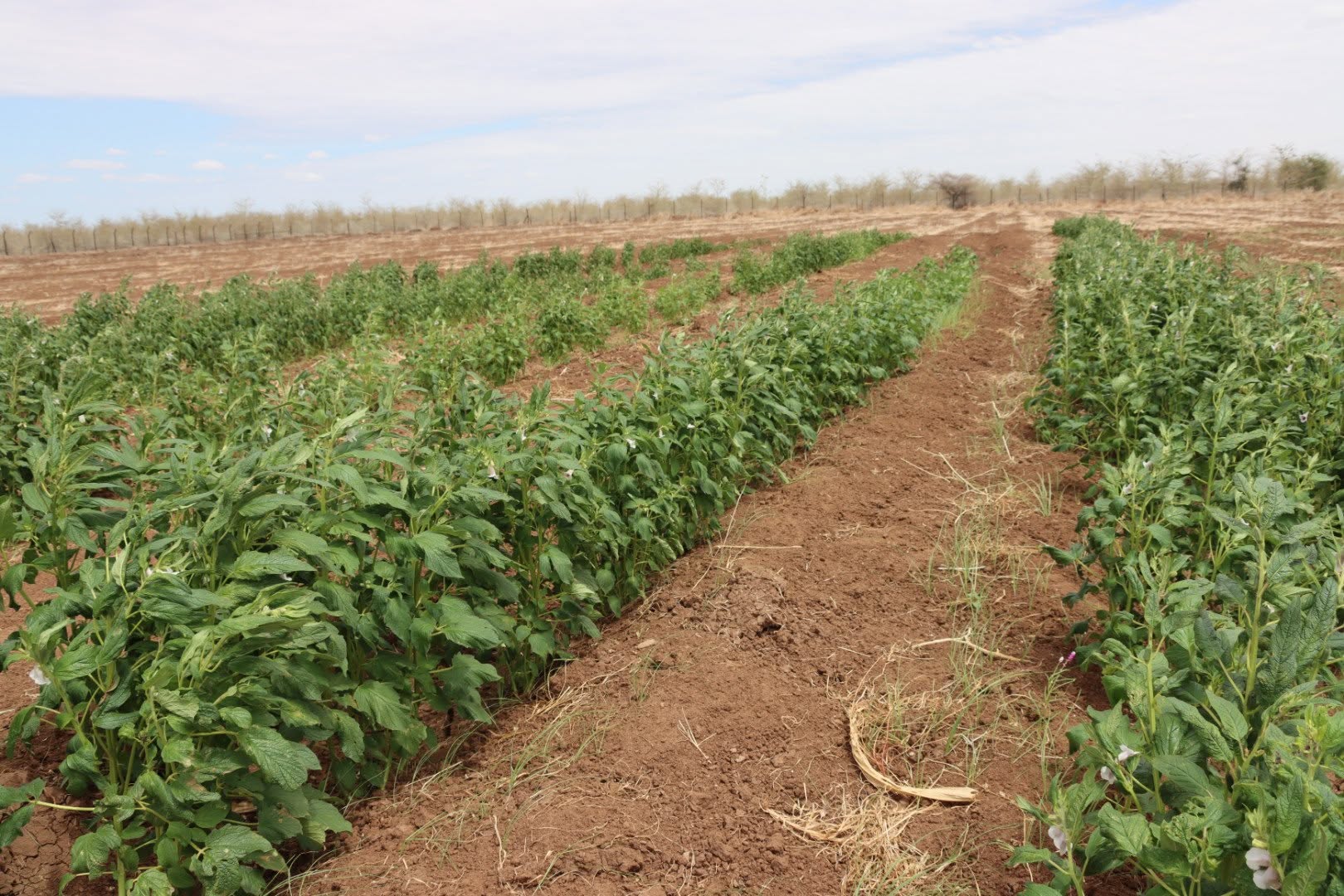
After losing 160 livestock during the 2021–2022 drought, Wajir farmer Abdirrahman Ali Hassan turned to fodder production as a strategy for building livestock resilience.
Hassan has expanded his Shaletey Farm from two to 10 acres, producing about 4,000 hay bales and 150 tonnes of silage for his herd and the wider livestock market.
With support from the Regional Livestock Programme, Hassan is helping promote commercial fodder production in Wajir while sharing planting materials, technical knowledge and practical skills with other farmers.
When the devastating 2021–2022 drought swept across northern Kenya, Abdirrahman Ali Hassan did everything within his means to keep his livestock alive.
The Wajir County livestock farmer bought commercial feed, sourced grass from as far away as the slopes of Mount Kenya and transported animals by truck in search of pasture and water. Some of his livestock were moved towards Garissa and across the Tana River in an attempt to find better grazing conditions. But the drought proved relentless.
By the time the crisis eased, Hassan had lost almost 100 cattle and 60 camels, representing between 80 and 90 per cent of his herd. The loss wiped out not only livestock but also a significant portion of the savings he had accumulated over the years.
“I also lost my savings as I struggled to save the livestock,” Hassan recalls.
The experience fundamentally changed his approach to livestock farming. Instead of waiting for the next drought to threaten his herd, he decided to invest in a way of producing and preserving livestock feed before pasture disappeared.
That decision has since grown into a commercial fodder enterprise at his Shaletey Farm in Wajir North, offering a potential new model for livestock resilience in one of Kenya’s most drought-prone regions.
For Hassan, the drought exposed the vulnerability of a livestock economy heavily dependent on natural pasture.
When rains fail for extended periods, grazing areas deteriorate, water sources dry up and livestock begin to lose their condition. As animals die, pastoralist households can lose the wealth and savings accumulated over years.
Hassan estimates that around 70 per cent of livestock in Wajir perished during the 2021–2022 drought.
The crisis also placed enormous pressure on household food security. According to Hassan, some families were forced to divert food intended for themselves to their animals as they struggled to keep their herds alive.
Determined not to experience another drought in the same way, Hassan began searching for alternatives in late 2023.
He travelled to farms in different parts of Kenya to learn how fodder was produced and researched varieties that could withstand conditions in Wajir.
At Shaletey Farm, he initially dedicated about two acres to fodder production, planting varieties including Juncao, Super Napier, Lusan and sweet potato vines.
“I invested in this. At the back of my mind, I thought I should prepare for the drought season so that it doesn’t affect me,” he says.
What began as a personal drought-preparedness strategy would soon become a commercial venture.
In 2024, Hassan came across an opportunity under the Regional Livestock Programme (RLP), implemented by Mercy Corps and partners.
Already experimenting with fodder production, he applied for a co-investment partnership. His proposal went through an interview and vetting process before the programme agreed to support the enterprise.
The arrangement required Hassan to contribute half of the investment, with RLP covering the other half through reimbursement after the agreed works had been completed and verified.
“In fact, the model is such that you implement, then they reimburse the percentage they agreed to cover,” Hassan explains.
The co-investment model allowed Hassan to retain ownership of the business while receiving support to expand the infrastructure and equipment required for commercial production.
RLP supported key infrastructure, including a water reservoir, an underground tank with a capacity of about 180,000 litres and fodder storage facilities.
Hassan complemented that support with his own investments in silage bunkers, processing facilities, choppers and hay balers.
The result was a significant expansion from the two-acre operation he started in 2023.
Hassan now has about 10 acres under fodder production.
The farm currently holds approximately 4,000 bales of hay and 150 tonnes of silage, transforming what was initially a drought insurance mechanism into a functioning commercial enterprise.
Outside the drought season, Hassan sells fodder to livestock farmers and traders who require feed for animals being transported to markets.
The emerging market is particularly significant in Wajir, where commercial fodder production is still relatively new.
“In Wajir, most people only know of natural pasture, natural grass, herding the animals, animals trekking,” he says. “The issue of fodder production is a new concept.”
Hassan's experience is gradually changing that perception.
He estimates that about 30 farmers across Wajir County have started producing fodder after seeing his work. Some have established larger farms and processing capacities than his own, while many have obtained planting materials from Shaletey Farm.
Hassan also provides technical advice to farmers seeking to establish their own fodder enterprises.
Beyond commercial production, Shaletey Farm has become a practical learning centre for farmers, students and livestock stakeholders.
Hassan describes the farm as a living laboratory where different fodder varieties are tested to determine which perform best under Wajir's conditions and which varieties livestock prefer.
The objective is not to replace natural pasture completely but to provide livestock keepers with an additional source of feed when grazing becomes scarce.
“It was and has been an eye-opener,” Hassan says.
Livestock training institutions now bring students to the farm, while extension officers organise practical learning sessions for farmers.
Other organisations have also brought pastoralists from different parts of the region to learn how to make silage and bale hay.
Visitors are given an opportunity to use the farm's equipment and participate in the production process under the guidance of Hassan's staff.
Hassan believes commercial fodder production in livestock-producing areas could also address the high cost of transporting bulky feed from Kenya's high-potential agricultural regions.
Fodder transported over long distances incurs substantial transport costs, which are ultimately passed on to livestock farmers.
According to Hassan, producing feed closer to livestock-producing communities could make fodder considerably cheaper, potentially reducing costs by as much as 50 per cent compared with feed transported from distant agricultural regions.
His vision therefore extends beyond his own farm.
He wants Wajir and the wider northern Kenya livestock belt to develop a local fodder industry capable of producing, processing and storing enough feed to support livestock through future droughts.
For Hassan, the central lesson from the 2021–2022 drought is that livestock resilience cannot begin after animals have already started starving.
Preparation, he argues, must begin while pasture is still available.
That is why he considers fodder production fundamental to the wider livestock value chain.
“We have to work on the grass first,” he stresses.
He argues that activities such as meat processing, slaughter, value addition and export depend ultimately on the survival and health of livestock.
“Meat processing, slaughter, value addition and export may be the visible branches of the livestock economy. But none can function without animals that survive long enough to reach those markets,” he says.
“Without these grasses, without the feed, we have no meat on the table.”
The approach represents a shift in thinking from responding to livestock losses during drought to preparing for dry conditions well in advance.
Despite the progress at Shaletey Farm, Hassan acknowledges that fodder production itself remains vulnerable to climate and water constraints.
The farm relies partly on a public water pan constructed by the National Drought Management Authority, which is also used by livestock and local residents.
During prolonged dry periods, the water pan can dry up, creating a challenge for fodder production.
Hassan has already experienced the consequences. At one point, approximately half of his Juncao crop dried up.
However, because he had retained planting material, he was able to recover the crop after the rains returned.
The experience reinforced his belief that no single fodder variety or intervention can eliminate climate risk.
Instead, he advocates for several layers of protection, including different fodder varieties, stored hay and silage, crops with different nutritional qualities and reliable water sources.
For him, resilience means ensuring that the failure of one source does not bring the entire livestock feeding system to a halt.
Hassan is no longer simply trying to rebuild the herd he lost during the 2021–2022 drought.
His broader ambition is to change the conditions under which future livestock herds are raised in Wajir and northern Kenya.
He hopes that greater awareness and investment in fodder production will help livestock keepers prepare for recurring drought cycles before they become emergencies.
“If this continues, and sensitisation and awareness is created, people will be much better prepared for the drought cycles that are to come,” Hassan says. “And the impact will be well mitigated.”
The growing number of farmers adopting fodder production suggests that the idea is gaining attention beyond Shaletey Farm.
For Hassan, the real measure of success is therefore not only the size of his own enterprise but whether other livestock keepers can develop their own sources of feed and reduce their vulnerability to drought.
Hassan's farm forms part of a wider effort by Mercy Corps and its partners to strengthen livestock systems in drought-prone parts of the Horn of Africa.
The Regional Livestock Programme is implemented by Mercy Corps in partnership with IGAD, Helvetas and Welthungerhilfe, with funding from the Swiss Agency for Development and Cooperation and the French Development Agency.
The programme focuses on strengthening livestock production, markets and resilience across regional livestock systems.
Rather than limiting its interventions to individual administrative boundaries, the programme works along livestock trade corridors, linking areas where animals are produced to the markets where they are eventually sold.
In Kenya, this includes livestock-producing areas in the north-east and wider regional corridors connecting Kenya with Somalia and Ethiopia.
The programme also takes a market-oriented approach to resilience.
Rather than attempting to provide the same intervention to every farmer, it seeks to demonstrate viable business models that can attract private investment and allow markets to grow around successful enterprises.
“We are not intending to scale it ourselves,” says Mercy Corps Regional Livestock Programme Director Dr Diba Dida Wako. “We demonstrate and we crowd in.”
For Hassan, the journey from losing nearly his entire herd to building a 10-acre fodder enterprise illustrates the importance of preparing for drought before it arrives.
His experience suggests that livestock resilience is not only about surviving the next dry season but also about building the infrastructure, knowledge and markets needed to keep animals fed when natural pasture fails.
In Wajir, where pastoral livelihoods remain closely tied to livestock, that shift could help turn fodder from an emergency commodity into a permanent part of the livestock economy.